
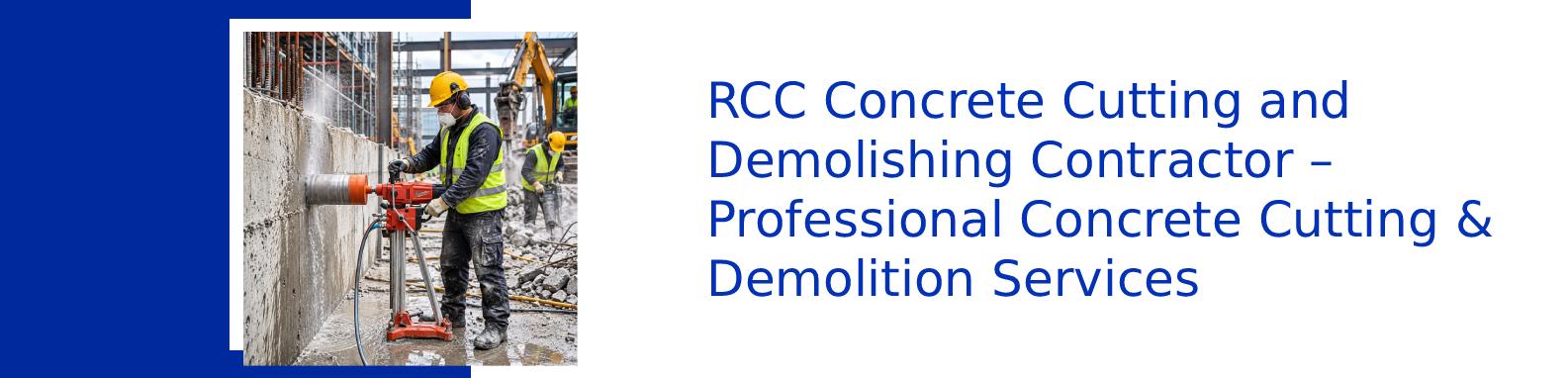
RCC Concrete Cutting and Demolishing Contractor
When modification, renovation, redevelopment or structural alteration work is required in an existing building, ordinary demolition methods are not always suitable. Reinforced Cement Concrete, commonly known as RCC, contains concrete combined with reinforcement steel, making it extremely strong and difficult to remove using conventional tools.
A professional RCC concrete cutting and demolishing contractor uses specialized machines, diamond cutting technology and controlled demolition techniques to cut, dismantle and remove RCC structures safely and accurately.
RCC cutting services are widely required for residential buildings, commercial properties, industrial factories, warehouses, hospitals, hotels, malls, infrastructure projects and redevelopment works.
Professional concrete cutting makes it possible to create precise openings, remove unwanted structural portions and modify existing RCC structures while reducing unnecessary vibration, noise and damage to surrounding construction.
Whether the requirement is for RCC slab cutting, RCC wall cutting, RCC beam cutting, column cutting, core cutting or complete concrete demolition, selecting an experienced contractor is important for safety, accuracy and project completion.
What Is RCC Concrete Cutting?
RCC concrete cutting is a specialized construction activity in which reinforced concrete structures are cut using machines fitted with diamond blades, diamond wires, core drilling bits or hydraulic equipment.
Unlike traditional demolition using heavy breakers, controlled concrete cutting allows a specific section of RCC to be removed without unnecessarily damaging adjacent areas.
The technique can be used on:
RCC walls
RCC slabs
RCC beams
RCC columns
Concrete floors
Foundations
Staircases
Retaining walls
Machine foundations
Bridges
Industrial structures
Concrete tanks
RCC roofs
Modern cutting machinery can cut both concrete and the steel reinforcement embedded inside it.
This makes diamond concrete cutting one of the most effective methods for structural modification and controlled demolition.
Professional RCC Concrete Cutting Services
An experienced RCC concrete cutting contractor can execute several types of cutting work depending on the site requirement, thickness of concrete, reinforcement arrangement and accessibility.
RCC Wall Cutting
RCC wall cutting is commonly required when creating new openings or modifying existing walls.
Typical applications include:
Door openings
Window openings
Lift openings
Ventilation openings
HVAC openings
Equipment access
Passage openings
Structural modification
Diamond wall saw machines provide clean and accurate cuts through heavily reinforced concrete walls.
Compared with manual breaking, wall sawing creates smoother edges and considerably reduces uncontrolled cracks.
RCC Slab Cutting
RCC slab cutting is one of the most commonly required services during renovation and structural modification projects.
Slab cutting may be required for:
Staircase openings
Lift openings
Service ducts
Plumbing shafts
HVAC installation
Electrical cable routes
Equipment foundations
Floor modification
Expansion work
Professional contractors normally inspect the slab thickness, reinforcement arrangement and structural condition before beginning work.
Slab cutting can be carried out using floor saw machines, wall saw machines or diamond wire cutting depending on the thickness and accessibility.
RCC Beam Cutting
Cutting an RCC beam requires technical planning because beams are structural members carrying building loads.
Beam cutting should therefore only be executed after approval from a qualified structural engineer.
Specialized diamond cutting equipment allows RCC beams to be cut into manageable sections with minimum vibration.
RCC beam cutting may be required during:
Structural alteration
Building renovation
Plant modification
Equipment installation
Redevelopment
Staircase modification
Industrial expansion
Before cutting starts, temporary structural supports may be installed depending on engineering requirements.
RCC Column Cutting
RCC columns transfer loads from the building structure to the foundation. Therefore, column cutting is a specialized activity requiring careful engineering consideration.
Controlled cutting techniques are used when an existing column needs to be removed or modified as part of an approved structural alteration.
Diamond wire sawing is often suitable for large RCC columns because it can cut thick and heavily reinforced concrete sections with high accuracy.
RCC Concrete Demolition Services
Concrete demolition involves dismantling or removing existing RCC structures either partially or completely.
Professional RCC demolition contractors use different methods depending on the size, location, thickness and structural condition of the concrete.
Services may include:
RCC wall demolition
RCC slab demolition
RCC beam demolition
RCC column dismantling
Foundation demolition
Machine foundation removal
Staircase demolition
Concrete floor removal
Building demolition
Industrial structure dismantling
Concrete tank demolition
Controlled structural demolition
The objective of controlled demolition is to remove the required portion while maintaining maximum safety for workers, nearby structures and equipment.
Controlled RCC Demolition
Controlled demolition is preferred when work needs to be carried out inside operational factories, commercial buildings, residential complexes or sensitive locations.
Rather than breaking concrete randomly with heavy breakers, the structure is divided into predetermined sections.
These sections are then cut and removed systematically.
Controlled demolition offers several benefits:
Reduced vibration
Reduced noise
Better structural control
Precise removal
Less damage to surrounding construction
Faster execution
Cleaner work area
Easier debris handling
This method is especially useful during renovation projects where only selected sections of RCC need to be removed.
Diamond Concrete Cutting
Diamond cutting technology has transformed the way reinforced concrete is modified and demolished.
Industrial diamond blades and diamond wire can efficiently cut extremely hard concrete together with reinforcement steel.
Professional diamond concrete cutting contractors use specialized machinery for accurate structural cutting.
Diamond cutting is suitable for:
Thick RCC slabs
Reinforced walls
Columns
Beams
Foundations
Bridge structures
Industrial concrete structures
The cutting process creates a straight and controlled finish compared with conventional breaking methods.
RCC Wall Sawing
Wall sawing uses a track-mounted cutting machine fitted with a diamond blade.
The machine is fixed to the concrete surface and travels along a predetermined cutting line.
Wall sawing is commonly used for:
Door openings
Window openings
Lift openings
Large wall openings
Structural alterations
Wall saw machines can cut vertically, horizontally and sometimes at specific angles depending on site requirements.
The method produces accurate and smooth cuts in reinforced concrete.
Floor Saw Cutting
Floor saw cutting is mainly used for horizontal RCC surfaces such as floors, pavements and slabs.
Floor saw machines are suitable for:
RCC slab cutting
Industrial floor cutting
Expansion joint cutting
Concrete road cutting
Foundation cutting
Trench creation
The depth of cutting depends on the machine capacity and blade size.
Floor sawing is generally faster and more efficient than manual concrete breaking for straight horizontal cuts.
Diamond Wire Saw Cutting
Diamond wire saw cutting is one of the most powerful techniques available for cutting large reinforced concrete structures.
A steel wire embedded with industrial diamond beads is wrapped around the concrete section. The wire moves continuously through the material, gradually cutting both concrete and reinforcement steel.
Wire sawing is especially useful for:
Massive RCC columns
Thick foundations
Bridge structures
Heavy beams
Large concrete blocks
Marine structures
Industrial structures
One major advantage of wire cutting is that there is practically no limitation on the thickness of the concrete section when proper access is available.
Core Cutting and Core Drilling
Core cutting creates circular openings in RCC walls, slabs and floors.
A diamond core drilling machine is used to create clean holes without excessive vibration.
Core drilling applications include:
Plumbing pipes
Electrical cables
Fire-fighting lines
HVAC pipes
Drainage lines
Cable trays
Anchor installation
Utility services
Hole sizes can vary depending on project requirements.
Core cutting is widely used in MEP installation and building modification projects.
RCC Staircase Cutting and Demolition
During renovation or architectural modification, existing RCC staircases may need to be modified or completely removed.
Professional contractors divide the staircase into manageable sections before dismantling.
Typical staircase work includes:
Staircase removal
Landing cutting
Staircase widening
Creating new openings
Modifying staircase direction
Controlled cutting reduces the risk of damaging connecting walls and slabs.
Machine Foundation Cutting and Demolition
Industrial plants frequently require removal of old machine foundations before installation of new machinery.
These foundations are often heavily reinforced and extremely thick.
Professional concrete demolition contractors use:
Diamond wire saws
Floor saws
Hydraulic breakers
Core drilling machines
Controlled breaking equipment
Machine foundation demolition requires proper planning because work is frequently carried out inside active factories.
Noise, vibration and dust therefore need to be carefully controlled.
RCC Foundation Demolition
Foundation demolition may be required during building redevelopment, equipment replacement or structural alteration.
Concrete foundations can contain significant quantities of reinforcement steel and may extend deep below floor level.
The demolition process generally includes:
Site inspection
Identification of foundation dimensions
Concrete cutting
Controlled breaking
Steel reinforcement cutting
Concrete block removal
Debris handling
Large foundations may be divided into smaller blocks using diamond saw cutting before lifting and removal.
Benefits of Hiring a Professional RCC Concrete Cutting and Demolishing Contractor
Concrete cutting and demolition involve significant structural and safety risks. Professional contractors bring trained manpower, proper equipment and systematic execution procedures.
Accurate Cutting
Diamond cutting machines enable precise cuts according to drawings and marking lines.
This is especially important when creating openings for doors, lifts, ducts and services.
Reduced Structural Damage
Traditional breaking generates strong vibration which may create cracks in surrounding concrete.
Controlled cutting significantly reduces unnecessary vibration and helps protect nearby structural elements.
Faster Execution
Specialized machinery can cut reinforced concrete much faster than conventional manual breaking.
This helps reduce shutdown periods and overall project duration.
Cleaner Finish
Diamond saw cutting creates straight and smooth edges.
In many cases, additional finishing work is considerably reduced.
Safer Working Method
Experienced contractors follow planned cutting sequences, equipment safety procedures and debris removal methods.
Suitable for Operational Buildings
Low-vibration cutting techniques are particularly useful in:
Hospitals
Hotels
Offices
Shopping malls
Factories
Residential buildings
Data centres
Commercial properties
Equipment Used for RCC Concrete Cutting
Professional contractors use specialized machines depending on the nature of the work.
Common equipment includes:
Diamond wall saw machines
Diamond wire saw machines
Floor saw machines
Core drilling machines
Hydraulic breakers
Electric breakers
Concrete crushers
Reinforcement cutting machines
Hydraulic splitters
Excavators
Cranes
Material handling equipment
Selecting the correct machine improves productivity and ensures safer execution.
RCC Concrete Cutting for Industrial Projects
Industrial factories frequently require structural modifications because production layouts and machinery change over time.
Common industrial applications include:
New machine installation
Production line modification
Equipment foundation removal
Pipeline installation
Cable trench construction
Floor openings
Structural modification
Utility installation
An experienced industrial RCC cutting contractor understands that many projects must be completed while surrounding operations continue.
For this reason, proper planning, barricading, dust control and scheduling are essential.
RCC Concrete Cutting for Commercial Buildings
Commercial buildings such as malls, offices and hotels regularly require modifications when tenants change or buildings are renovated.
Concrete cutting services may be required for:
New elevators
Escalator openings
Staircase modification
HVAC installations
Plumbing services
Electrical services
Fire-fighting systems
Door openings
Architectural modifications
Using controlled cutting allows renovation work to proceed while reducing disturbance to surrounding areas.
RCC Concrete Cutting for Residential Buildings
Homeowners and developers may require concrete cutting when remodeling existing houses, apartments or residential buildings.
Typical residential requirements include:
Creating door openings
Increasing window size
Removing RCC walls
Cutting slabs for staircases
Plumbing core holes
Structural renovation
Terrace modification
Before cutting structural elements, professional engineering approval should always be obtained.
RCC Demolition for Redevelopment Projects
Redevelopment projects often involve partial or complete removal of existing concrete structures.
Controlled demolition may be preferred where nearby buildings are very close or where parts of the original structure need to remain.
A professional demolition contractor can plan the sequence so that the building is dismantled systematically.
Typical redevelopment work may involve:
Slab removal
Beam dismantling
Column removal
Wall demolition
Foundation demolition
Complete structural dismantling
Dust-Controlled Concrete Cutting
Dust is one of the major challenges during concrete cutting.
Professional contractors commonly use wet cutting systems where water is continuously supplied to the cutting blade.
This helps:
Reduce airborne dust
Cool the cutting blade
Improve cutting performance
Increase blade life
When wet cutting is not suitable, industrial vacuum systems and dust extraction equipment may be used.
Low-Vibration Concrete Demolition
Heavy concrete breakers produce significant impact and vibration.
In sensitive structures, excessive vibration may affect nearby walls, machinery or finishes.
Diamond cutting offers a low-vibration alternative.
The concrete is first cut into sections and then carefully removed.
This technique is frequently used in hospitals, laboratories, factories and occupied commercial properties.
RCC Cutting for Lift Openings
Creating a new lift shaft or modifying an existing one often requires slab and wall cutting.
Typical work includes:
Slab opening
RCC wall cutting
Landing modification
Beam cutting where structurally approved
Core drilling
Debris removal
Precise measurements are critical because lift installation requires accurate dimensions.
RCC Cutting for HVAC and MEP Services
Mechanical, Electrical and Plumbing installations frequently require openings through RCC slabs and walls.
Typical requirements include openings for:
Air-conditioning ducts
Plumbing pipelines
Electrical cables
Drainage pipes
Fire-fighting pipes
Ventilation ducts
Cable trays
Core drilling and diamond wall cutting provide clean service openings with minimum disturbance to the existing structure.
Safety During RCC Concrete Cutting and Demolition
Safety is one of the most important considerations in concrete cutting work.
Before work begins, the contractor should assess:
Structural stability
Electrical services
Plumbing lines
Gas pipelines
Reinforcement layout
Access conditions
Falling material hazards
Equipment positioning
Typical safety arrangements include barricading, PPE, temporary supports, lifting arrangements and controlled debris removal.
Heavy concrete sections should never be allowed to fall without proper planning.
Importance of Structural Engineer Approval
Concrete cutting contractors perform the physical cutting work, but structural decisions must be made by qualified engineers.
Before removing any structural element such as a beam, column, slab or load-bearing wall, the proposed modification should be reviewed by the project structural consultant.
The engineer may recommend:
Temporary supports
Additional beams
Steel strengthening
Jacketing
Structural framing
Revised reinforcement
This ensures that the remaining building continues to carry loads safely.